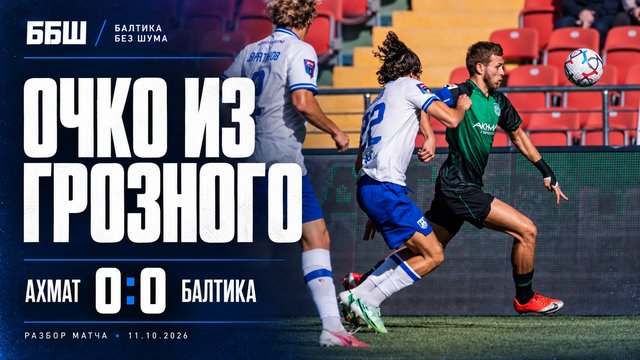
On October 11 Baltika return to league football. Their last RPL match was on September 16 — that 2:3 against Zenit, when after 0:2 and 1:3 the team only cut the gap to a single goal. Akhmat last played a day later: 0:2 away to Akron in Samara, a man down from the 37th minute.
That makes for a strange tenth round. By the calendar it is the season continuing. By feel it is a small second start.
The teams come into it side by side: Baltika have 11 points and eighth place, Akhmat 10 points and tenth. Kick-off in Grozny is at 14:00 Moscow time; in Kaliningrad it will be 13:00.
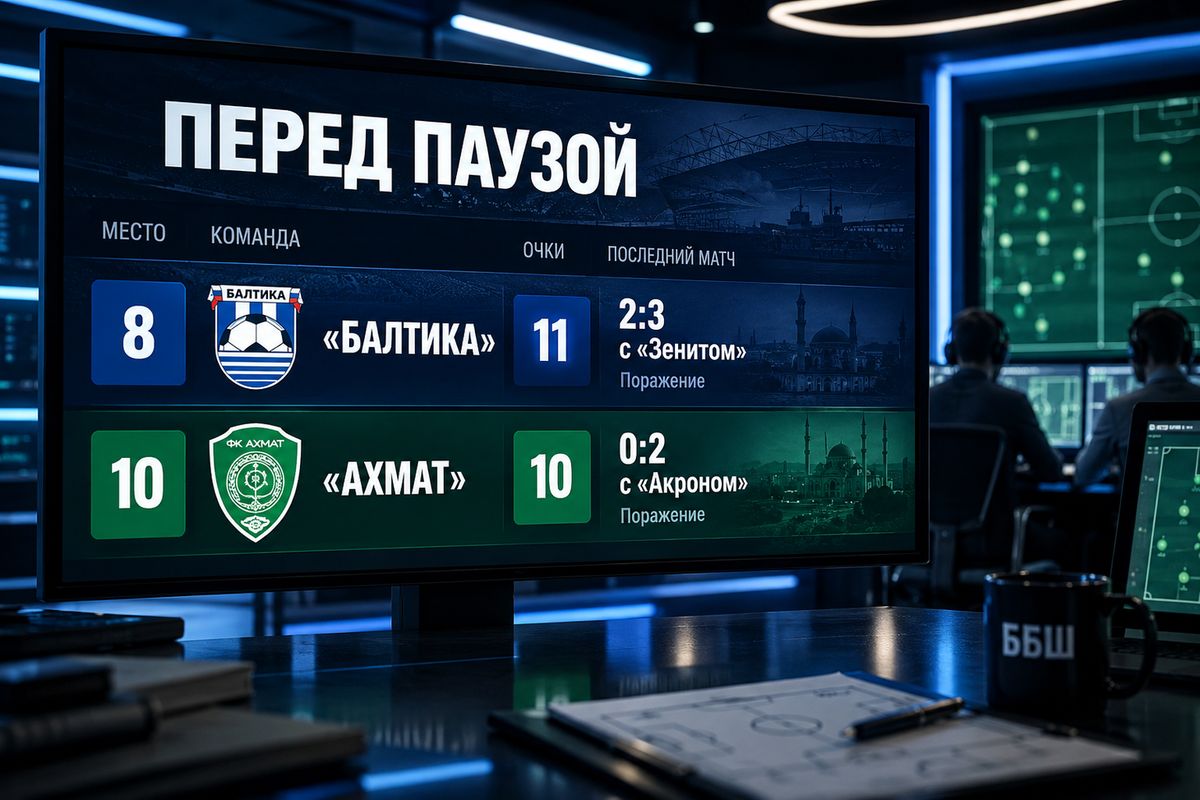
The break was long. Not everyone got a rest
Akhmat held a ten-day camp in Belek and closed it on September 30 with a 2:1 win over the Turkish side Batman Petrolspor. Baltika trained in Kratovo, then in Kazan, where they stay until October 10. On October 3 they lost 0:1 to Rubin — Gripsha's goal from a free kick. Lads from Baltika-2 featured heavily: Gasanbekov, Iva, Medvedev. A second friendly, against Neftekhimik, was cancelled.
Akhmat had one more friendly: on October 5 in Vladikavkaz they thrashed Alania 6:1. Kasadzhikov scored a hat-trick, Konate got a brace. The internationals, naturally, took no part in that game.
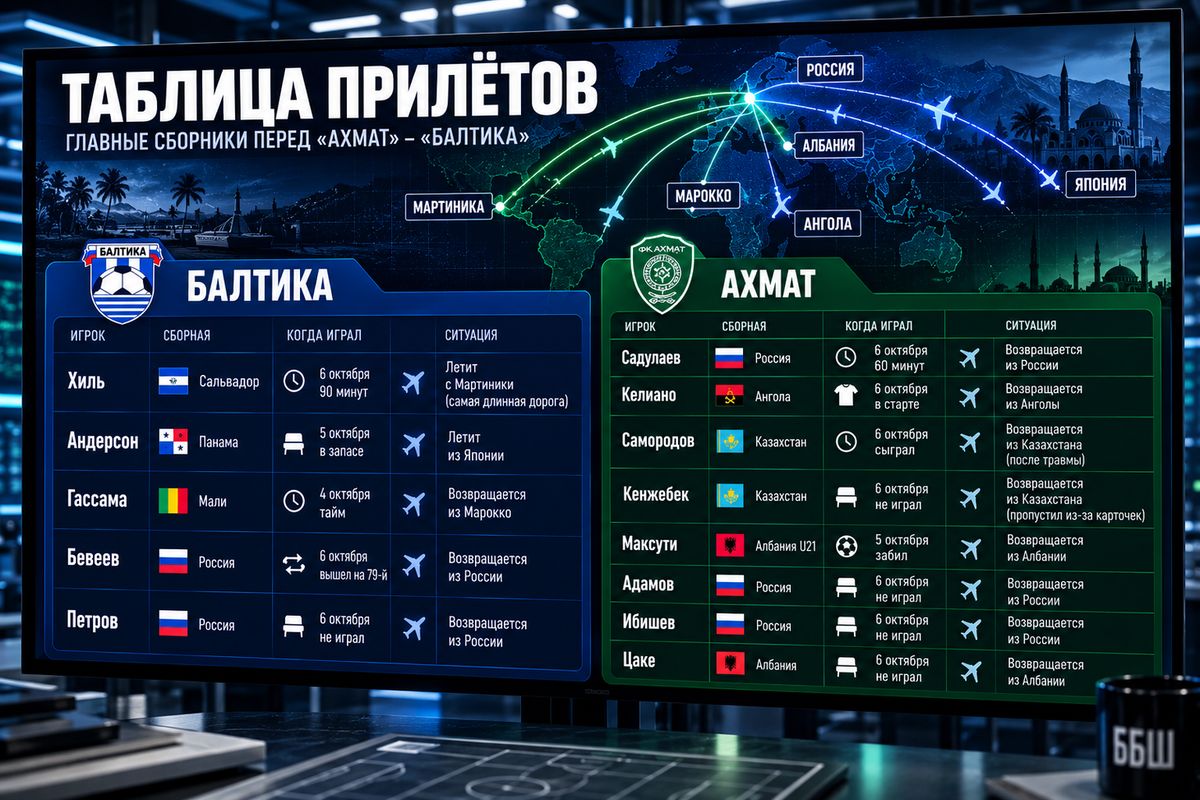
The main thing about this break, though, is elsewhere. Akhmat sent eight players off to national teams: Kenzhebek, Samorodov, Adamov, Ibishev, Sadulaev, Tsake, Maksuti and Keliano. Baltika sent five: Beveev, Maksim Petrov, Gil, Anderson and Gassama.
And these were not box-ticking call-ups. On October 3, in Russia's match against Namibia (6:0), Beveev played the whole game; Petrov came on in the 77th minute and still managed an assist and a penalty goal. Sadulaev and Adamov of Akhmat were in the starting line-up, Sadulaev opened the scoring, and Ibishev came on together with Petrov. Gil played 90 minutes for El Salvador against Jamaica; Gassama a half against Morocco.
Then came the most inconvenient part. For ten of the thirteen players called up, their national teams' closing matches of the window were scheduled for October 6 Moscow time — five days before Grozny. Maksuti's and Anderson's window ended on the 5th, Gassama's as early as the 4th. The players themselves, though, got very different workloads.
And this is how the window ended. In Russia's match against Nigeria (3:3) Sadulaev scored again and spent an hour on the pitch. Beveev only came on in the 79th minute, while Petrov, Adamov and Ibishev didn't come on at all. On the night of October 6 Moscow time Gil played the full 90 minutes in Martinique (1:1). Anderson sat out the whole of Panama's third-place match against Ecuador at the Kirin Cup — in Japan. For Akhmat, Maksuti scored late for Albania's under-21s (2:2 with Ukraine), Keliano started for Angola against Malawi (3:1), and Tsake stayed on Albania's bench. Samorodov picked up an injury with Kazakhstan in late September and missed the first matches, but returned for the game against the Faroe Islands and set up the goal for 2:2. Kenzhebek, meanwhile, missed that game through an accumulation of yellow cards. So he returns to Akhmat with no minutes in the window's final match.
A curious picture emerges. Of Baltika's players, only Gil was seriously loaded in the window's last round — but he has the longest journey, from the Caribbean. At Akhmat, several first-team regulars carried a load at once: Sadulaev, Samorodov, Keliano. They can play. The question is what physical state they will be in by October 11.
So the league table matters before this game. But the arrivals board may matter no less.
Akhmat love the ball. Baltika love the space behind it
In style the teams differ noticeably.
Akhmat have more possession — 48.3% against 42.0% — and more passes, 5,235 against 4,497, and they are more accurate by seven percentage points: 81.7% against 74.6%. The Grozny side hold the ball more calmly and give it away cheaply less often.
And then Baltika begin. With less of the ball they have entered the box 226 times against 189, taken 153 shots against 148 and hit the target 61 times against 52.
The most telling number is passes into the box: 493 for Baltika and 316 for Akhmat. And the Kaliningrad side's accuracy is higher — 55% against 47%. In other words, Baltika not only deliver the ball into the box more often but also find a teammate there more often.
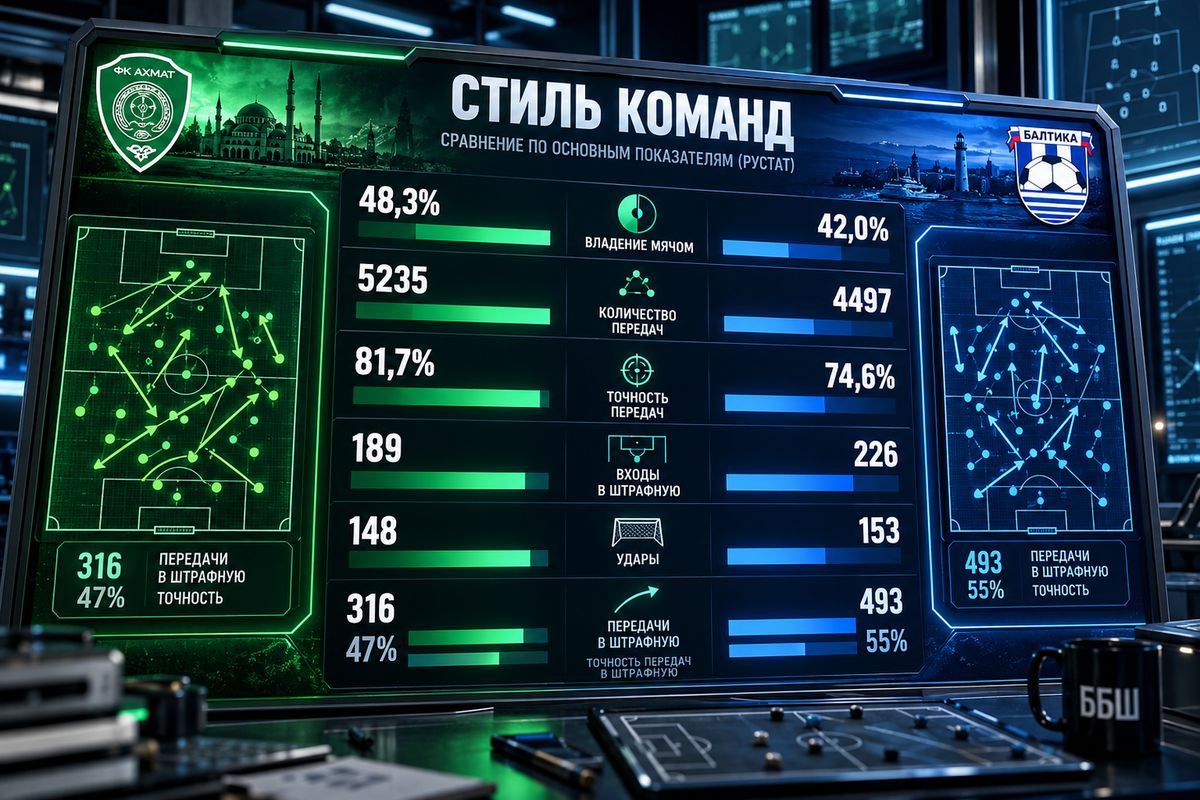
In short: Akhmat think longer with the ball, Baltika look faster for where to send it. The whole match will revolve around that difference.
Where Baltika can catch Akhmat
The most interesting pair of numbers is pressing and turnovers.
Baltika have 289 team pressing actions, Akhmat 209. But what matters more is how they end: the Kaliningrad side convert half of their attempts (50.5%), the Grozny side four in ten (40.2%).
And at the same time Akhmat have lost the ball 155 times in their own half — against Baltika's 121.
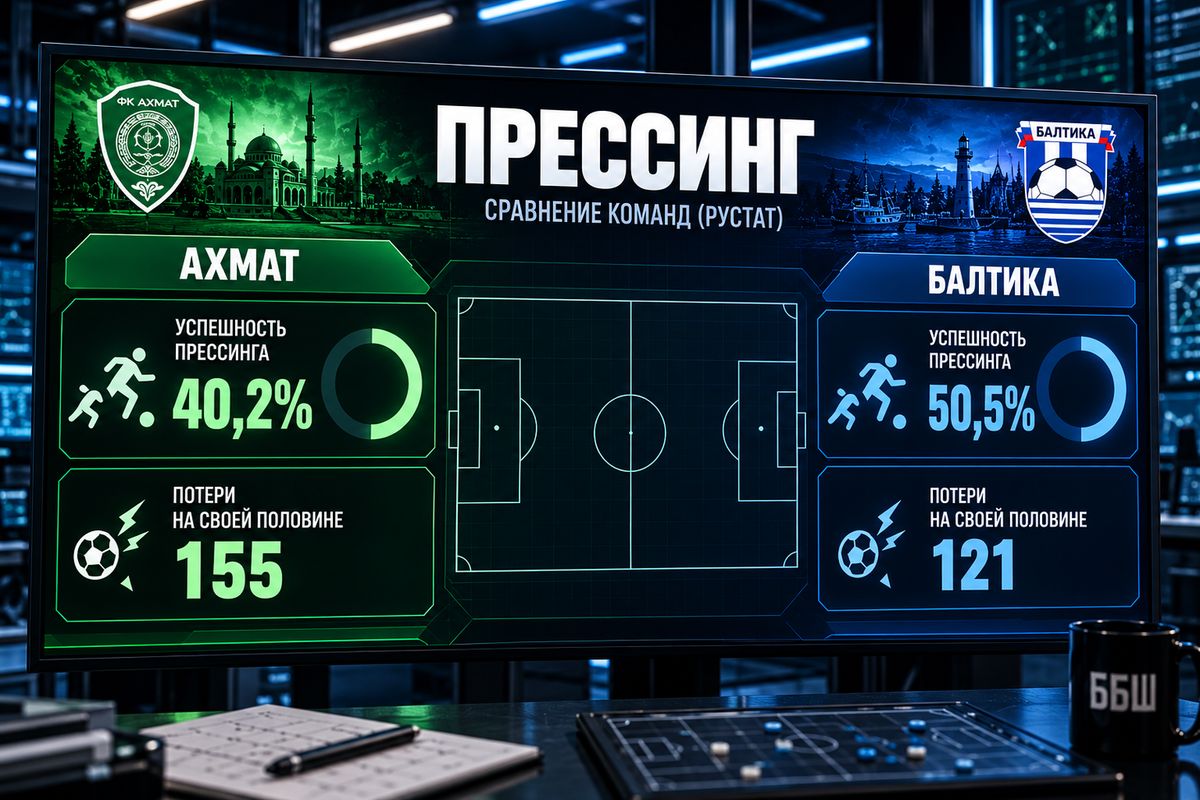
Hence the main storyline. Baltika do not need to take the ball off Akhmat. It pays to hand it over: let the hosts build up, then squeeze the first or second pass and, after winning it, be at the box within a couple of touches. The opponent nominally has the ball but has to keep looking over their shoulder. A very Baltika scenario.
What will be unpleasant for Baltika
If Baltika are stronger in pressure and directness, Akhmat have noticeably more one-on-one play. 345 dribbles against 187, with 63.8% successful against 52.9%. Put simply, the Grozny side go for a take-on almost twice as often and beat their man more reliably.
According to RuStat, Kasintura has 3+2 this season and has created 11 goalscoring chances. Sadulaev has 2+3. Samorodov is Akhmat's leader in passes into the box, with 67. These are players who can remove a defender on their own and create an overload where a second ago it was even.
At least the top scorer is out. Melkadze, who has four goals, was shown a straight red in Samara for an elbow and will miss the Baltika game. Talalaev makes no secret of it: "Clearly it gets a little easier for us. In the first nine rounds Melkadze was a formidable force." Without a forward who latches onto every ball, it becomes even more important for Akhmat to get their technicians facing the goal.
So the most dangerous zones are by the flanks of Baltika's defence. If the press arrives one pass late and Kasintura or Sadulaev turn with the ball, the structure doesn't always save you from there.
And set pieces again
Both teams have seven scoring attacks from set pieces. But Akhmat punish from corners more often — four goals against Baltika's two.
Baltika, meanwhile, have contested almost twice as many aerial duels — 890 against 458. That number is not about quality but about the character of the game: under Talalaev the ball seems to travel through the air more often, and it has to be fought for. Which means any needless foul near their own box in Grozny could cost more than twenty minutes of good football.
And what about fitness?
Before the break Baltika's advantage in volume was very visible. By the available RuStat fitness sample, Talalaev's team averaged about 120.3 km per match, Akhmat about 114.1 km. Sprints — roughly 573 against 491; sprint distance — about 1.90 km against 1.81.
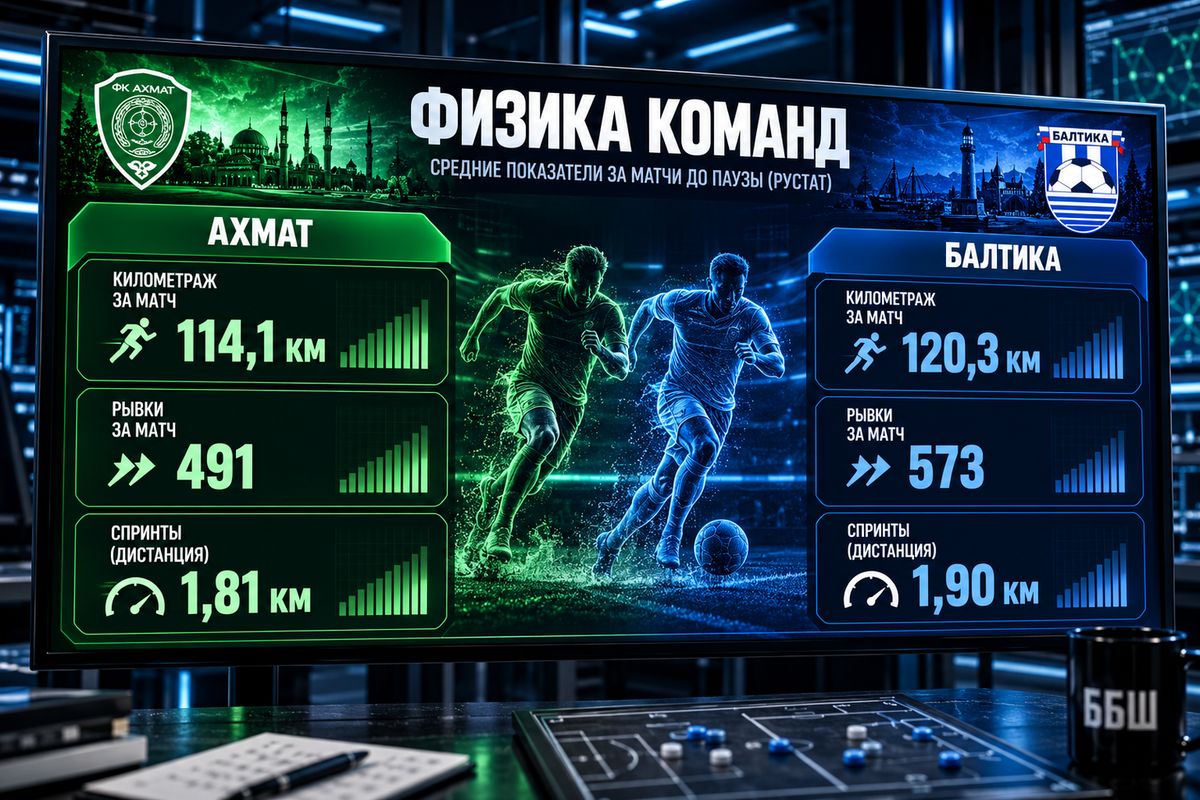
Six extra kilometres per game sit well with the higher pressing and duel volumes from the previous sections.
But it is precisely these numbers that deserve the most caution right now. After three and a half weeks without a competitive match, and with national-team trips stretching from Nizhny Novgorod to Martinique and Japan, you cannot simply take the average 120 kilometres from the matches before the break and transfer them automatically to October 11.
The question is not whether Baltika can outrun Akhmat. They can. The question is whether they can do it right now.
The match I expect
I don't think Baltika will go to Grozny to fight for possession. Nor should they. It is more logical to concede Akhmat their usual percentages, close the centre and wait for the pressing moment: the opponent wants to play out more, and makes more mistakes in their own half.
Akhmat, in turn, have no interest in turning the match into a series of duels. They need to stretch Baltika, get Sadulaev, Kasintura and Samorodov into one-on-ones and wait for set pieces.
The first twenty minutes may be a separate match altogether: after a pause like this, both teams will be relearning their own rhythm.
So I don't consider Baltika the underdog. By the table the teams are side by side; in pressure and in progressing the ball towards the box the Kaliningrad side have clear advantages, and the hosts will be without their top scorer.
But the main unknown before the match is recovery. Beveev barely played in the last game, Petrov and Anderson didn't come on at all, while Gil returns after 90 minutes in Martinique. Cherchesov has his own quest: Sadulaev played an hour against Nigeria, Samorodov featured against the Faroes after a recent injury.
The ball will belong to Akhmat, the penalty box to Baltika. That much is clear already. But who weathered almost a month without league football better — only October 11 will tell.