In the Premier League, one goal is scored from roughly every 49 long throw-ins. I decided to see how Baltika compare. I went through 163 throw-ins by Mingiyan Beveev, found three goals and discovered that the most important part often begins only after the ball has left his hands.
In the first minute against CSKA, Beveev took a throw. Gassama flicked it on, Offor scored.
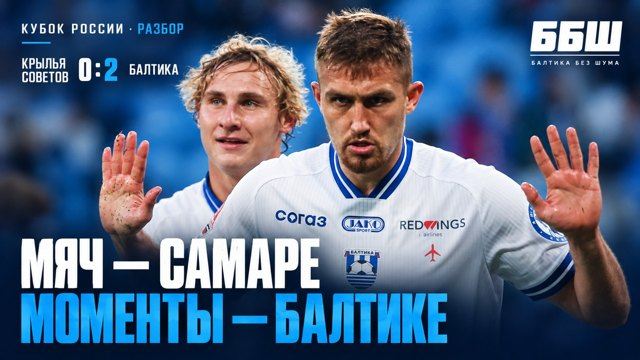
In the third minute against Krylia Sovetov, Beveev again. Offor competed for the first ball, Murid collected the second ball and fed Civic. Goal.
In the 23rd minute against Spartak, another long throw. Aerial duel in the box, the clearance drops to Mendel, shot. Goal.
Three matches. Three different scorers. The same beginning.
All three goals came in the first four league rounds, and two of them arrived before the opposition had really had time to break sweat.
A throw-in used to be treated as little more than a way to restart play. Baltika, apparently, decided that putting the ball back in play without a specific purpose is an unacceptable luxury. If you're going to throw it, throw it closer to goal. Then see what happens.
But are long throws really that effective? Or do three goals look impressive only until you count the attempts that led nowhere?
I found an Opta study, opened RuStat and tried to work it out.
In England everyone is throwing long. Hardly anyone is scoring
On 20 March 2026, Opta Analyst's Ali Tweedale published an article with a deliberately provocative title: "Are long throw-ins really a waste of time?"
There was a reason for the question.
In each of the previous five Premier League seasons, teams averaged no more than 1.52 long throws per match. In 2025/26 that figure rose to 3.92 — more than two and a half times higher.
Long throws had become fashionable. Every Premier League team had thrown the ball directly into the opposition box at least five times. Nine clubs did it at least twice per match.
One of the trendsetters was Brentford. In 2024/25 they scored six goals from long throws — almost as many as the rest of the league combined. By March of the following season they had added another five.
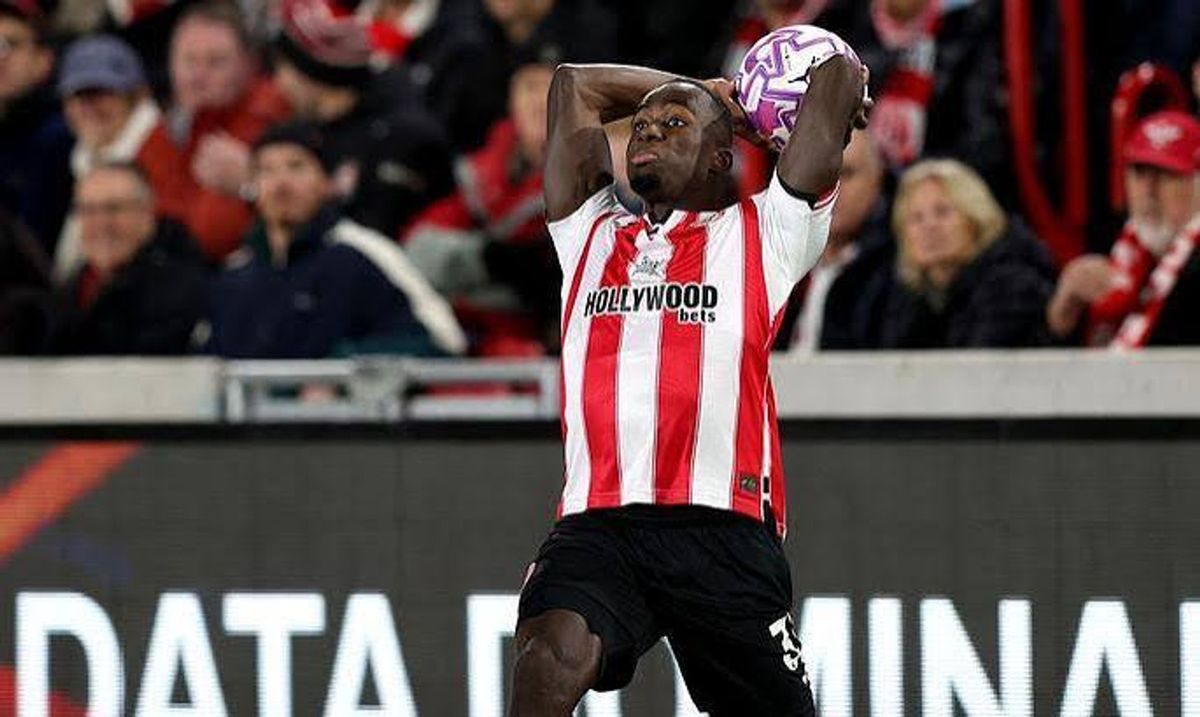
The others looked at that and, apparently, thought: if it works for them, why not for us? So they tried.
Across 301 matches of the 2025/26 season, Premier League teams took 1,179 long throw-ins and scored only 24 goals from them.
One goal every 49.1 throws. A conversion rate of 2.04%.
Tottenham, for example, took 74 long throws and did not score from a single one =)
For comparison, Premier League teams scored 123 goals from 2,564 corners delivered directly into the box. One goal every 20.8 corners.
So corners were more than twice as effective.
There is another interesting figure. According to Opta, in 2025/26 teams spent an average of 10 minutes 42 seconds per match waiting for throw-ins to be taken — almost two minutes more than a year earlier.
That figure covers all throw-ins, not only long ones.
Authorities have already started tackling the delays. In the summer IFAB introduced a five-second rule: if the referee believes a player is taking too long over a throw, the referee can start a countdown and award possession to the opposition. The Premier League has used the new interpretation this season. After five rounds, the average throw-in took 15.3 seconds, down from 17.8 a year earlier, and possession had already been handed to the other team four times.
So the English analysts had an obvious question: are clubs simply wasting too much time on a relatively low-yield attacking method?
That made me wonder: what about Baltika?
After all, we have Beveev, who can launch a throw so far that opposition centre-backs start looking for the ball before it has even left his hands.
163 throw-ins. Almost every second one goes into the box
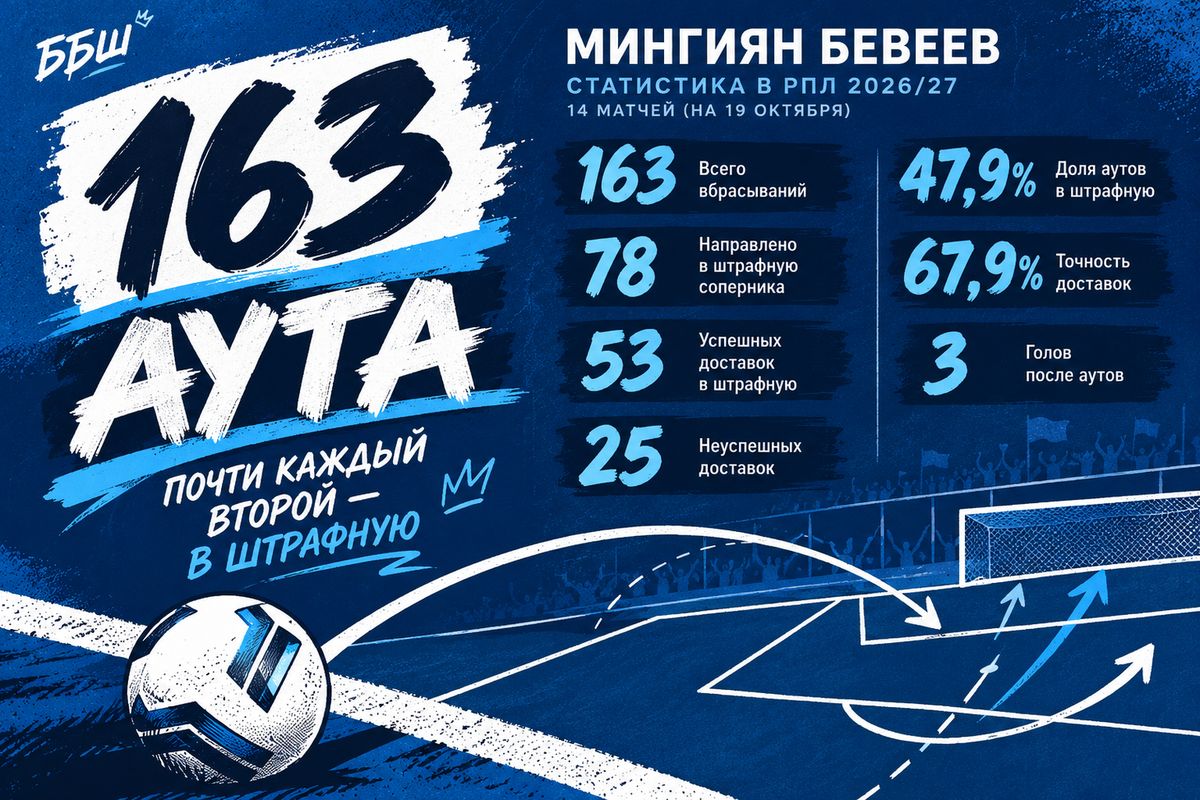
I took Mingiyan Beveev's RuStat data from 14 matches of the 2026/27 season, up to 19 October.
The sample includes league and Russian Cup matches. All three goals came in the league.
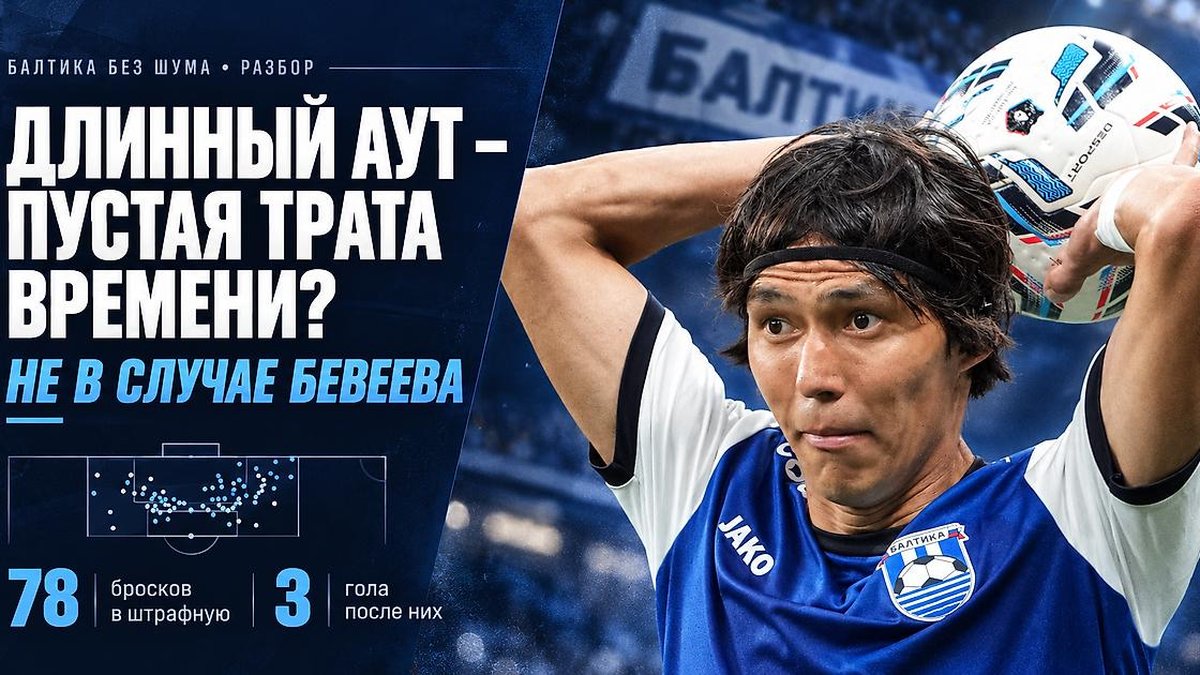
Almost half of Beveev's throw-ins went directly into the opposition penalty area.
And these were not hopeful attempts to chuck the ball as far as possible just to get it closer to goal.
RuStat's map shows most of them being aimed at specific zones: the central part of the box, the six-yard area and the spaces around its corners.
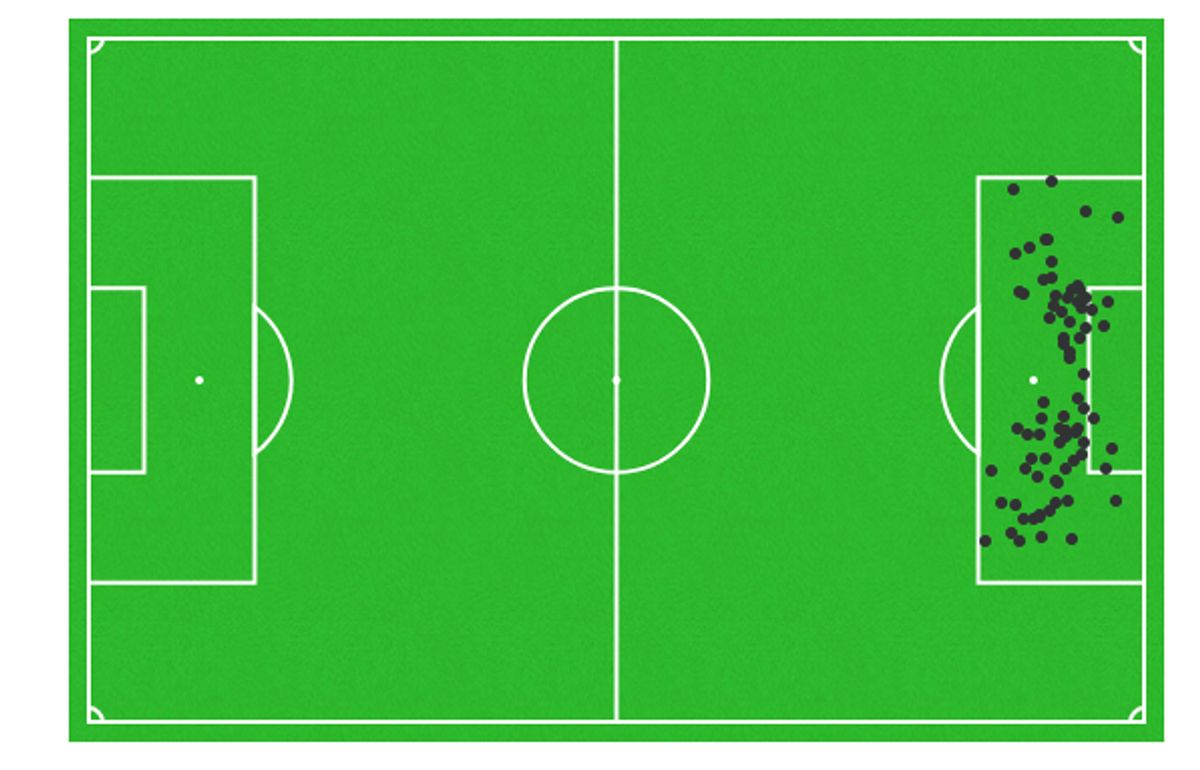
RuStat counts 53 of the 78 deliveries as successful — by its criteria, a teammate gained possession after the throw.
One caveat is important: a successful throw is not the same thing as a chance. A teammate can receive the ball and then misplace the flick-on, lose the second ball, or see the attack simply die.
Still, a 67.9% success rate is worth attention.
For Baltika, the long throw is clearly not a party trick saved for special occasions. It is a regularly used way of moving the ball straight towards the opposition goal.
Now let's look at what happened when it worked.
Goal one. CSKA: one minute was enough
24 July. RPL, round one. Moscow.
The match had barely started when Baltika won a throw near the opposition box.
Beveev sent the ball into the middle. Gassama won the first aerial duel and flicked it on to Offor. Offor headed in the opener.
Final score: CSKA 2-1 Baltika. Offor's goal: 1st minute.
It looks simple enough.
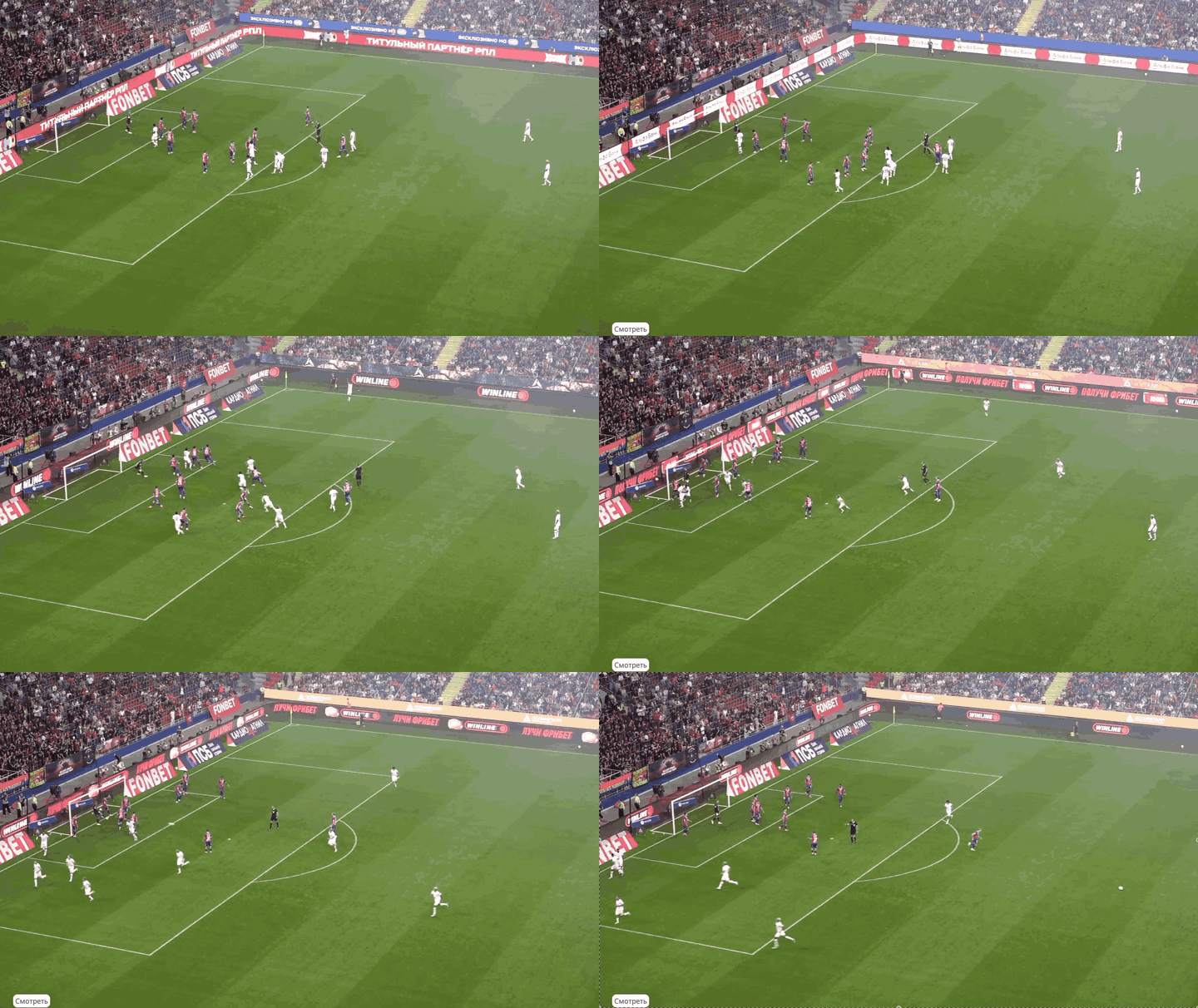
One player delivers. Another wins the first aerial ball. A third attacks the space where the flick-on is expected to fall.
All three actions happen so quickly that the defence has almost no time to reorganise.
Baltika eventually lost, but their first goal of the new league season came from a throw-in.
No warm-up period required.
Goal two. Samara: now with an extra pass
8 August. Round three. Away to Krylia Sovetov.
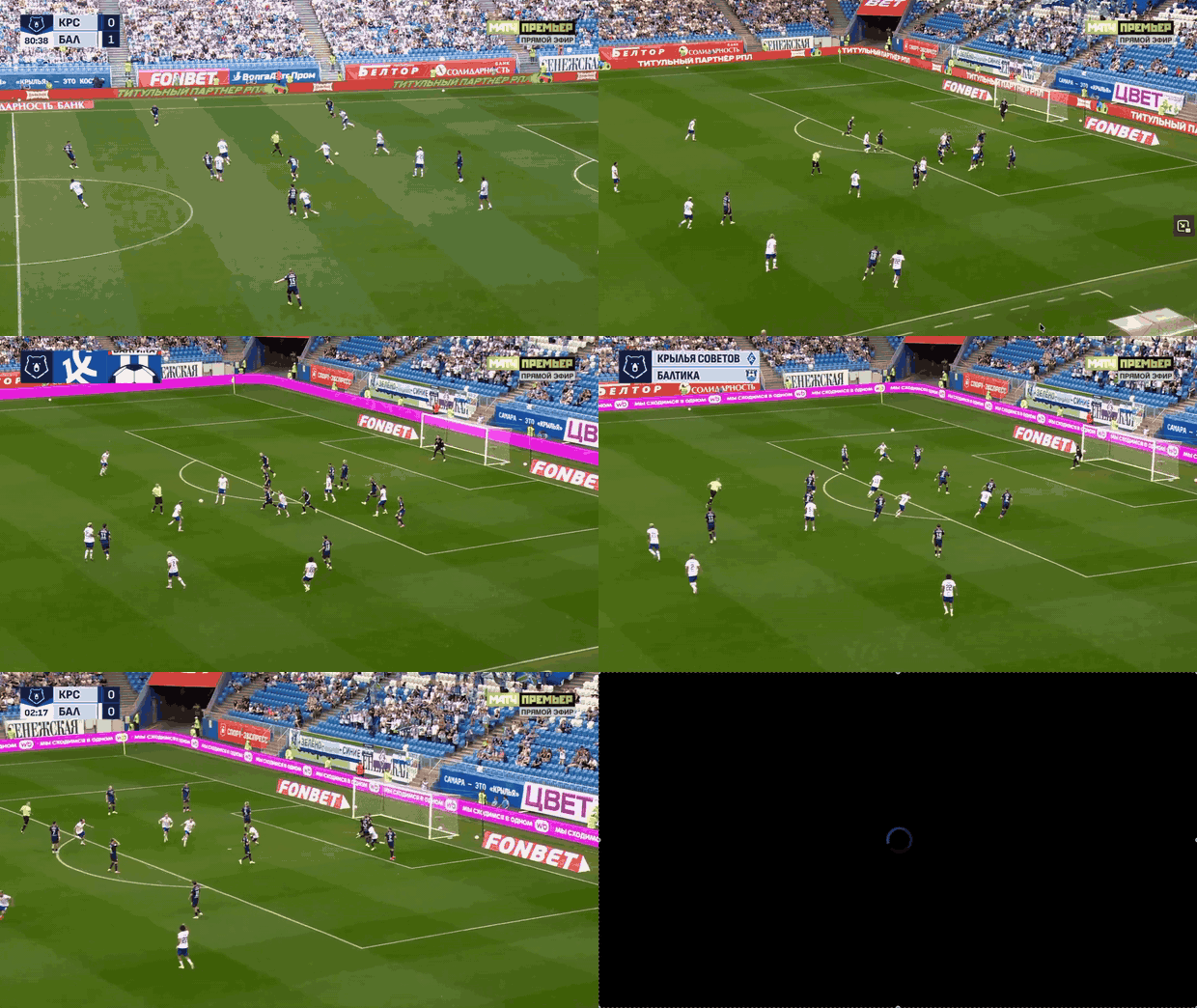
In the third minute, Beveev again launched the ball into the area.
Offor challenged for the first ball. After the flick and rebound, Murid was first to the second ball. He played it to Civic, who opened the scoring with a precise finish.
Final score: Krylia Sovetov 0-2 Baltika. Civic's goal: 3rd minute.
Unlike the first example, this move needed an extra pass. That makes it more interesting.
A long throw does not have to turn immediately into a shot. Its job can simply be to put the ball into a dangerous area and give the team a chance to extend the attack.
Defenders may even win the first duel. If the attacking team collects the second ball, the set piece is not over. That is exactly what Baltika exploited in Samara.
A second goal from a throw in three rounds. Again, right at the start of the match.
Goal three. Spartak: thanks for the clearance
16 August. Kaliningrad. Round four. Spartak went ahead in the 20th minute, but their lead lasted only briefly.
Beveev threw the ball into the box. Gassama challenged for the aerial ball. Spartak defender Christopher Wooh tried to clear the danger but headed it towards Mendel.
Mendel had already set himself for the second ball and struck on the half-volley under Maksimenko's crossbar.
Final score: Baltika 1-2 Spartak. Mendel's goal: 23rd minute.
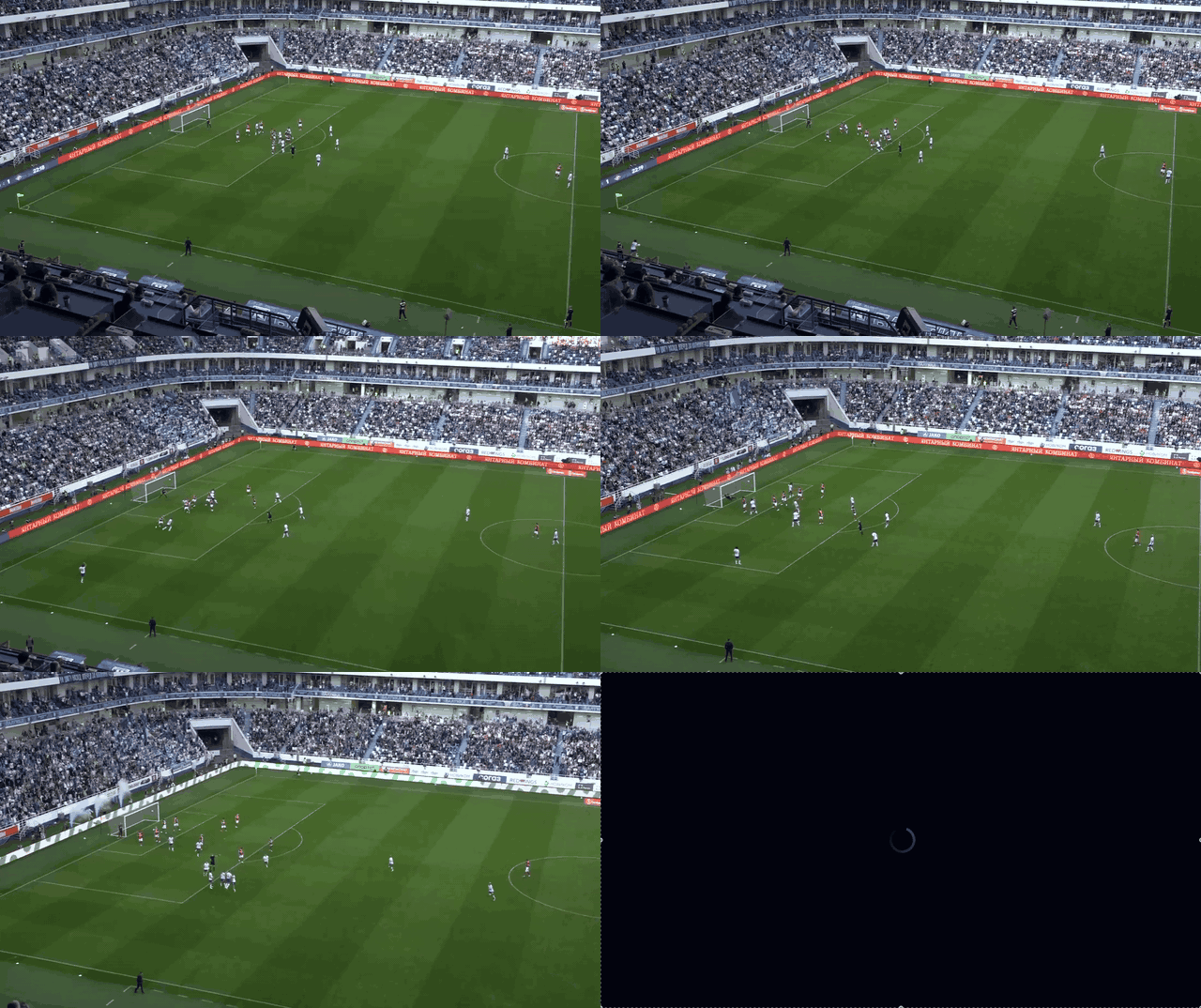
A third variation.
In the first case, a clean flick-on led directly to the goal.
In the second, Baltika needed the second ball and another pass.
In the third, the opposition defender's poor clearance did the favour.
But the principle stayed the same: put the ball into the box, force a duel and be ready to attack the second phase.
In the last example, the defender actually did what he was supposed to do: got the ball away from goal.
It just turned out he had not got it far enough.
A year ago the throws were dangerous, but not productive
Baltika's long throws are not a new invention. Almost exactly a year ago, Aleksandr Dorsky and Pavel Tikhonov analysed them on Sports.ru.
After 11 rounds of the 2025/26 season, only Rostov had sent more throw-ins into the opposition box than Baltika. The pattern was already recognisable: Beveev throws from either flank, Gassama positions himself near the six-yard box, Varatynov attacks from the edge of the area.
But there were no goals. The only direct reward was a penalty against Orenburg, after Titkov was first to the second ball following Gassama's duel. There were also two dangerous Varatynov chances against Zenit, a Petrov shot after Mendel's flick against Krylia, and a few lesser efforts.
This season brought three goals in the first four rounds. The tool is the same, but Baltika appear to have become better at finishing the move.
There was another detail in that earlier study. Baltika took longer than any RPL team to prepare throw-ins: more than 16 seconds on average for throws in the opposition half. From this season the referee may begin the five-second count if a throw is being delayed. That did not prevent the goals: all three came under the new rules.
Three goals from 78 deliveries. Is that a lot?
Back to the numbers.
3 / 78 = 3.85%. One goal for every 26 deliveries into the box.
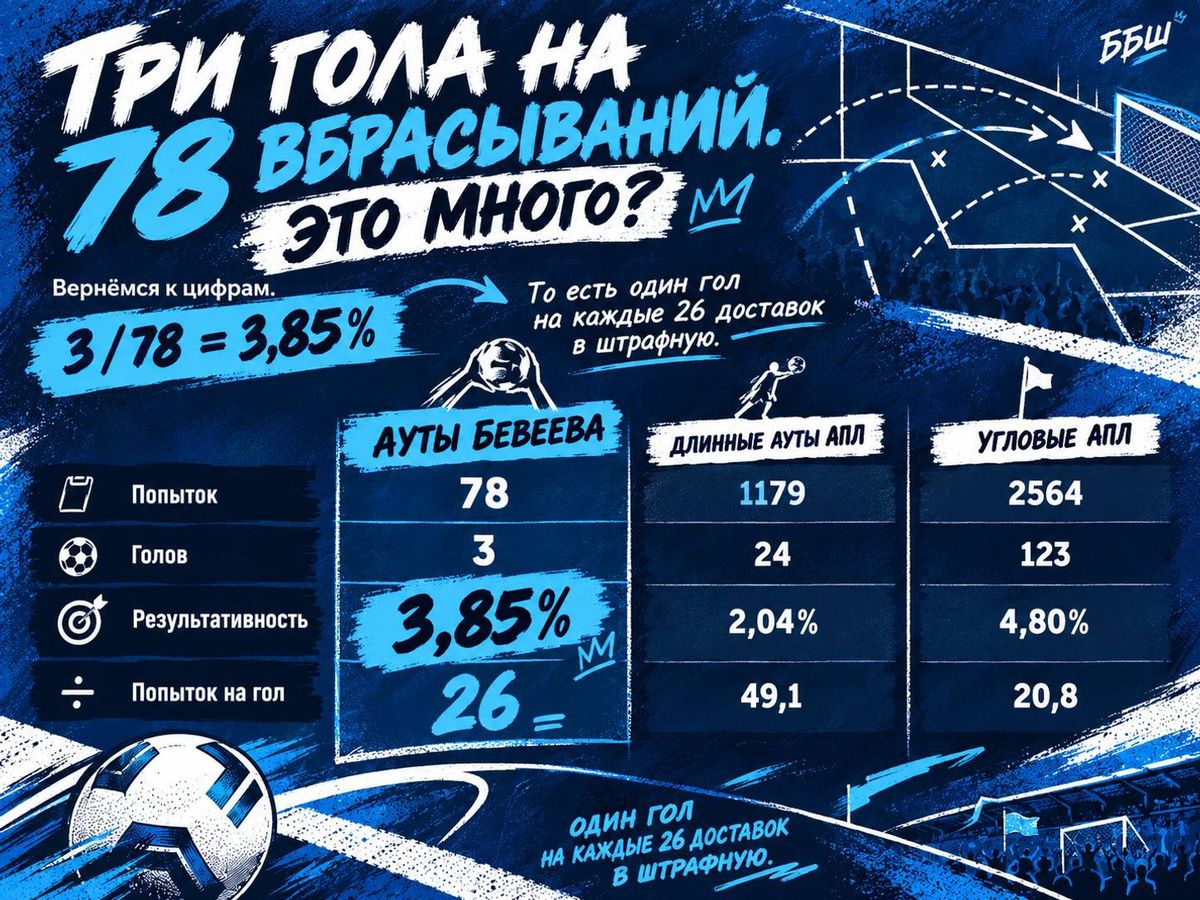
Look at the final line. In attempts per goal, Beveev's throws sit closer to English corners than to English long throws.
But an important caveat is needed.
Opta defines a long throw as one travelling at least 20 metres and being aimed into the box. Our RuStat sample counts deliveries into the penalty area without separately checking the 20-metre threshold. Our tally also includes a goal following an opposition clearance — we do not know whether Opta's methodology would classify that sequence in the same way.
The English sample covers an entire league across 301 matches. Ours covers one player over 14 matches in two competitions. And three goals are simply too small a sample: one extra goal would change the percentage substantially.
So the fairest wording is this: in our sample, goals followed Beveev's deliveries more often than they did long throws in Opta's Premier League data. Different methodologies and the small number of goals mean that cannot be treated as proof of a real advantage.
There is another limitation I have not yet been able to solve.
RuStat lets you count the throws themselves, their direction and their success rate, but I could not automatically extract every shot that followed one.
And there were dangerous attacks beyond the three goals. In the 69th minute against Spartak, for example, Civic collected the second ball after a Beveev throw and hit the post.
I do not yet know the total xG of attacks following his throws or the exact number of resulting shots. So I am not going to invent numbers I do not have.
Three goals are a fact. Everything else needs a separate count.
The most important thing about Beveev's throw is not Beveev
Look again at the three goals.
Gassama contests the first ball twice. Offor features in two of the scoring moves: once as the scorer, once by helping Baltika keep the attack alive.
Murid wins the second ball and makes the pass. Mendel positions himself correctly for the rebound.
So a long throw is not an individual trick performed by a player who happens to have a big throw.
It is collective work.
One player restarts play. Another competes in the air. A third prepares for the flick-on. A fourth occupies the second-ball zone.
You can teach a player to throw 30 metres. If his teammates are not prepared for the first and second contact, the throw will usually remain nothing more than a handsome arc through the air.
Baltika have shown several different continuations of the same idea. It looks systematic — though without access to training it would be wrong to claim that every combination is pre-rehearsed.
In England clubs hire specialist coaches for this
On 11 October 2026, Bristol City announced the appointment of the club's first specialist set-piece coach.
The job went to 35-year-old Ben King, previously a set-piece analyst at Sheffield Wednesday. He was brought in by head coach Michael Skubala, who had previously managed Lincoln City.
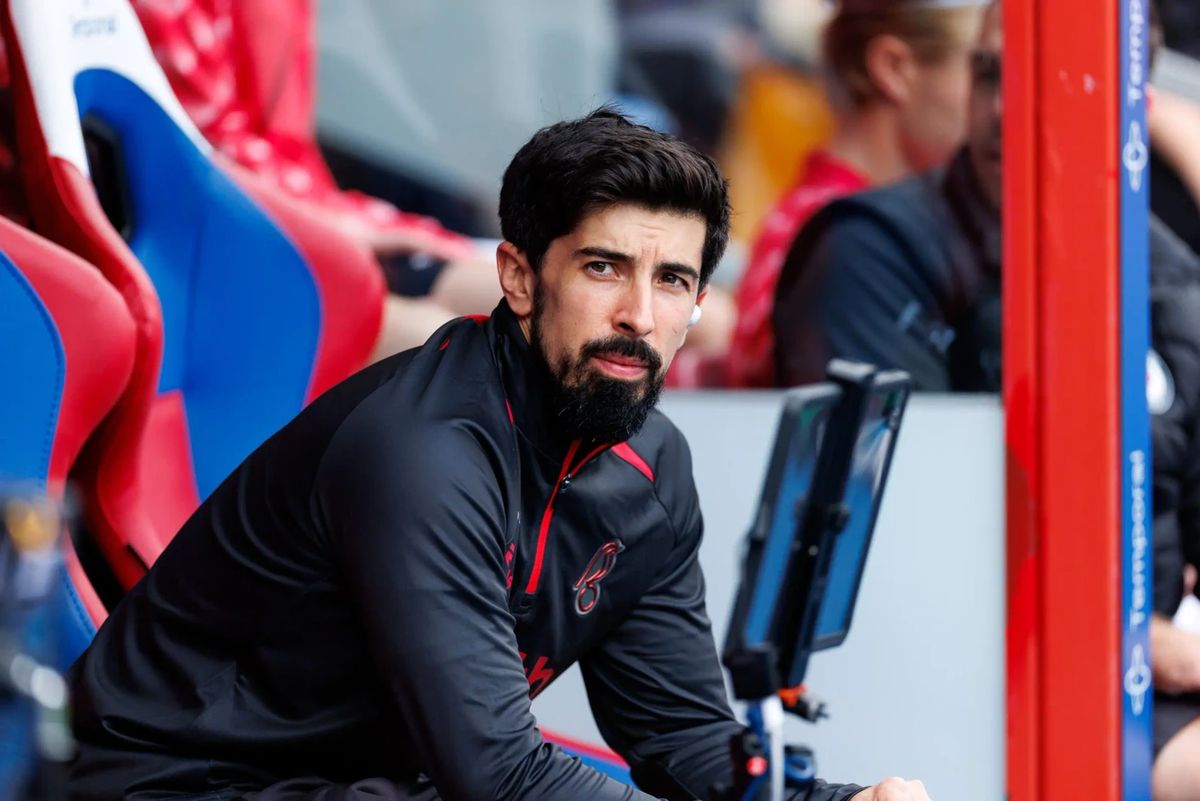
Lincoln are an especially interesting example.
In 2024/25 they scored 30 goals from set pieces — more than any other club in the English Football League. The following season Lincoln won League One, with set pieces accounting for 27 of their 77 goals.
Skubala explained that the work was not limited to corners and free-kicks. The club tried to maximise every situation in which play restarted after a stoppage.
Including throw-ins.
Lincoln used an artificial-intelligence tool that analysed thousands of set pieces from matches around the world. The data informed training and opponent-specific preparation.
Skubala himself stressed the obvious caveat: no amount of analysis matters if the findings remain on a screen. The edge appears only when the players can execute the idea on the pitch.
While some English clubs are still debating whether long throws are worth the time, others are hiring dedicated set-piece specialists and looking for marginal gains in every restart. And these are not the richest Premier League sides, but clubs in League One and the Championship.
I do not know whether Baltika use similar analytical tools or how much training time the staff devote specifically to long throws.
But these three goals show that the team have meaningful ways to continue the attack after them.
So are long throws a waste of time or not?
Back to the question raised by the English analysts.
Opta's point is fair: the fact that everyone is using long throws does not automatically make them efficient. Maybe it is better to restart quickly and short. Maybe training time is better spent on other attacking patterns.
It depends on how well a team uses the particular tool.
In all three Baltika goals, the continuation after the first ball was crucial. Two came in the first and third minutes. The third brought a quick equaliser against Spartak.
That alone does not prove long throws are more effective than other set pieces. To make that argument we would need the full data for shots, chances and expected goals.
But it does show something else: Baltika can turn Beveev's throws into an organised attacking set piece.
There is, however, one worrying detail. All three goals came in the opening four rounds. Since then Beveev's throws have not produced another goal. The pattern itself has not disappeared: Beveev still throws, Gassama still attacks the first ball. The net simply stopped bulging.
Have opponents studied the routine and learnt how to stop it? Or is this just normal statistical noise, with the goals likely to return? The next matches will tell us.
A throw-in is not merely a way to put the ball back on the pitch. Sometimes it is a way to drop an opponent immediately into a situation they do not have time — or do not know how — to solve.
In England, clubs are already creating dedicated coaching roles and bringing artificial intelligence into that search for an edge.
In Kaliningrad, for now, we have three goals and a man who starts those attacks with both hands.
Offor. Civic. Mendel.
Three arguments for the idea that a long throw can be a weapon.
And if an opponent thinks the ball going out for a throw finally offers a chance to catch their breath, they should first check who is walking over to take it.
If it's Beveev, the break is postponed.
You can take throw-ins for Beveev yourself here: https://www.baltiho.ru/throw-in/